Mia Otto · 14 October 2026
Leaf Tessellation Projects Revealing Geometric Principles in School Mathematics Curricula
Integration of Natural Materials in Geometry Lessons
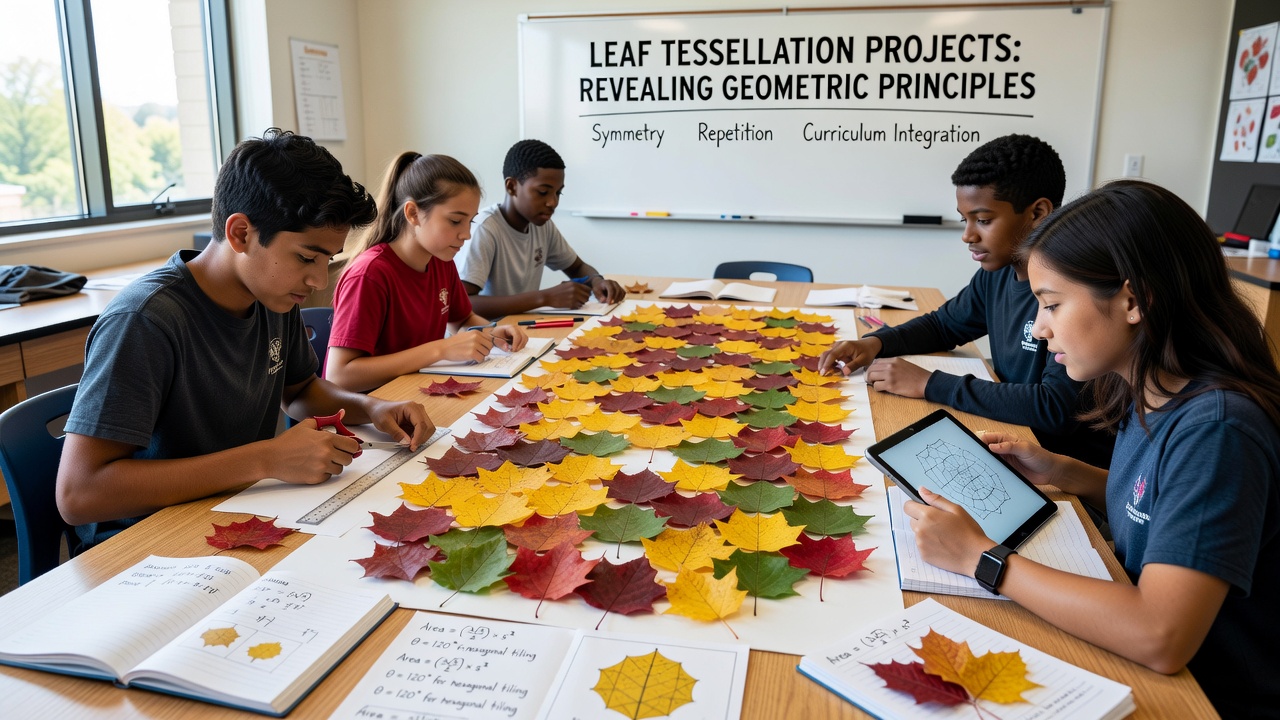
Educators incorporate leaf tessellation projects into mathematics curricula because these activities allow students to explore symmetry, angle measurement, and spatial relationships through direct manipulation of organic shapes, and researchers note that such hands-on methods connect abstract geometric concepts to observable patterns in the environment while students collect leaves, measure their edges, and arrange them to cover surfaces without gaps or overlaps.
Data from curriculum studies show that tessellation exercises using leaves appear in elementary and middle school programs across multiple regions, where instructors guide participants through identification of regular polygons formed by leaf outlines and calculation of interior angles that permit complete tiling, and observers record higher engagement levels when lessons combine botany with plane geometry principles.
Core Geometric Concepts Addressed by Leaf Arrangements
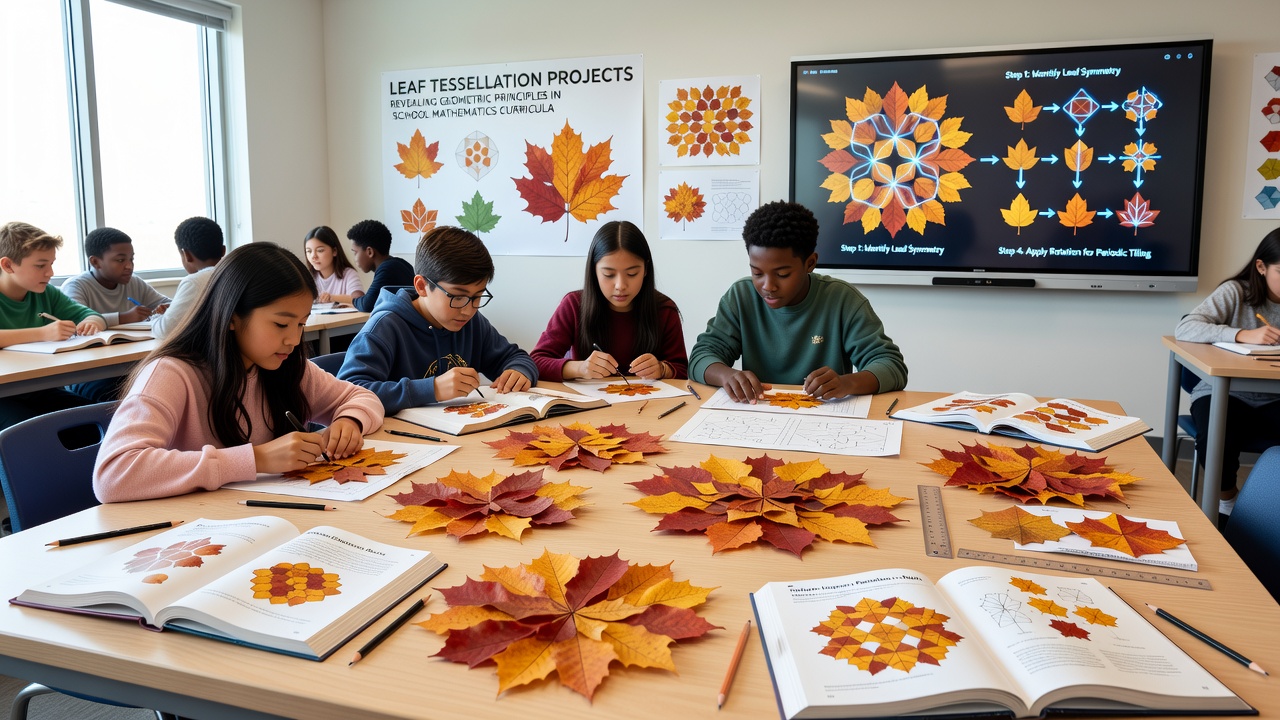
Leaf tessellation tasks highlight translation, rotation, and reflection symmetries because students must repeat individual leaf shapes across a plane while maintaining consistent orientations, and curriculum frameworks list these transformations as foundational topics that appear before formal proofs of congruence, with instructors providing templates that demonstrate how irregular natural forms can still satisfy the mathematical requirements for periodic tiling.
Figures from educational assessments indicate that students who complete leaf-based projects demonstrate improved accuracy in identifying vertex angles and calculating sums that equal 360 degrees at meeting points, and program evaluations track progress through pre- and post-activity measurements of shape recognition skills.
Implementation Across Different Educational Systems
School districts in North America and Europe schedule leaf tessellation units during autumn months when foliage is abundant, and lesson plans specify collection protocols that preserve leaf integrity for repeated classroom use, while mathematics coordinators align these projects with standards published by the National Council of Teachers of Mathematics that emphasize visualization and spatial reasoning as essential competencies.
In Australian classrooms, similar activities integrate with the national curriculum's geometry strand, where teachers document student work through photographs of completed leaf mosaics and require written explanations of the transformation sequences applied, and reports from participating schools list measurable gains in student performance on standardized tests covering pattern identification.
Assessment Methods and Observed Outcomes
Teachers evaluate leaf tessellation projects through rubrics that score accuracy of angle calculations, completeness of surface coverage, and clarity of written reflections on the geometric rules applied, and longitudinal data collected by provincial education ministries in Canada show consistent correlations between project participation and later success in coordinate geometry units.
Program records indicate that October 2026 marks the rollout of revised modules in several districts that incorporate digital scanning of leaf arrangements to verify mathematical properties, allowing automated feedback on symmetry compliance while maintaining the tactile component of physical leaf manipulation during initial design stages.
Connections to Broader Mathematics Standards
Curriculum designers link leaf tessellation exercises to topics in measurement and data analysis because students record dimensions of leaves used and graph frequency distributions of successful tiling configurations, and alignment documents from international education bodies emphasize that these projects provide concrete entry points for concepts that later extend to algebraic expressions of periodic functions.
Training materials distributed to instructors include protocols for adapting projects to different grade levels, with younger students focusing on simple edge matching and older groups advancing to analysis of aperiodic arrangements that still cover planes using multiple leaf varieties.
Conclusion
Leaf tessellation projects continue to serve as practical vehicles for conveying geometric principles within school mathematics programs, supported by documented alignments to established standards and measured improvements in spatial reasoning metrics across participating regions, and ongoing curriculum updates scheduled through 2026 maintain the integration of natural materials with formal geometry instruction.